The difference between spendable change and a collectible 1998 quarter isn’t dramatic — it’s microscopic.
The year 1998 marked the final stage for the eagle-reverse series before the launch of the 50 State Quarters Program.
Production occurred on a regular basis to meet the cash circulation needs of the United States.
Technical parameters of the coin strictly follow the standards established by the Coinage Act of 1965.
Spoiler: Circulated specimens are valued at face 1998 quarter value due to the lack of scarcity.
| Parameter | Value |
| Weight | 5.67 grams |
| Diameter | 24.26 mm |
| Clad Composition | 75% Copper, 25% Nickel |
| Core | 100% Copper |
| Thickness | 1.75 mm |
A weight deviation exceeding 0.2 grams indicates a production error or chemical wear of the metal.
Statistical Mintage Figures by Mint
Total production exceeded 1.7 billion units distributed among the primary manufacturing facilities.
High mintage determines the availability of coins in standard condition and forms a low entry threshold for researchers of this year.
| Mint Facility | Mint Mark | Mintage |
| Philadelphia | P | 896,268,000 |
| Denver | D | 821,000,000 |
| San Francisco | S | 2,086,507 |
Coins bearing the S mark were produced exclusively for collector sets, never entering direct circulation channels.
Value Drivers Based on Condition
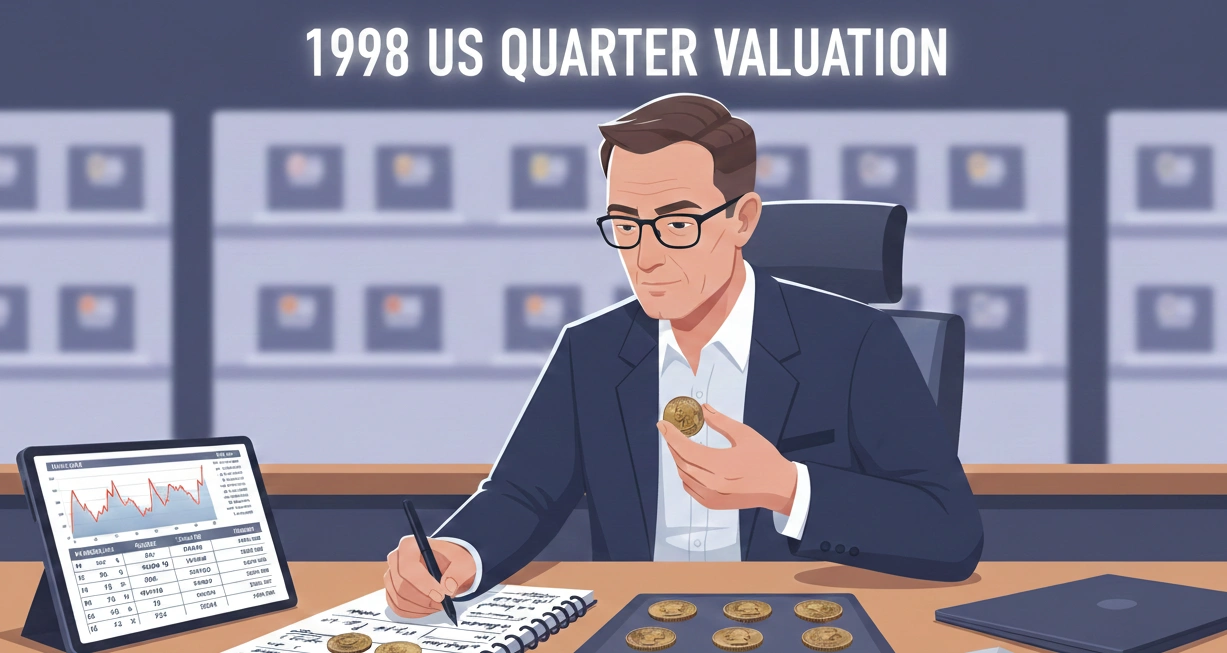
The market price of a 1998 quarter depends directly on surface preservation measured by the Sheldon scale.
Investment interest centers on coins receiving a certificate in MS66 grade or higher.
| Grade | 1998-P | 1998-D | 1998-S Silver |
| MS63 | $0.25 | $0.25 | — |
| MS65 | $5.00 | $5.00 | $15.00 |
| MS66 | $18.00 | $15.00 | $28.00 |
| MS67 | $45.00 | $60.00 | $55.00 |
| MS68 | $550.00 | $800.00 | $220.00 |
Coins in MS68 condition are extremely rare, representing less than 0.01% of all certified samples.
Price Dynamics Over a Ten-Year Perspective
Analysis of auction data for the period from 2014 to 2024 shows uneven value growth.
The average annual price increase for specimens in perfect condition is 4.2%.
For standard coins in MS65 condition, the price remains stable, demonstrating zero dynamics over the last eight years.
In 2019, a price jump of 12% relative to the previous period occurred for the 1998-D in MS68 grade.
By 2023, the market stabilized, fixing the value at $750 for a top-tier coin from Denver.
Record Sales and Auction Statistics
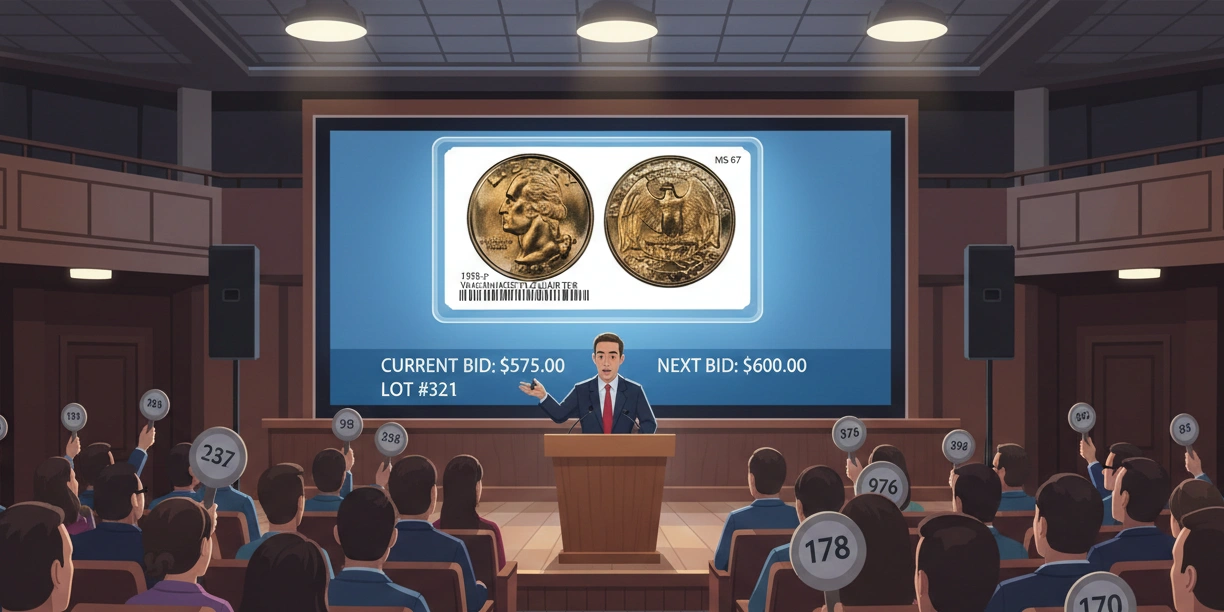
Public auctions confirm the existence of abnormally high prices for coins with exceptional characteristics.
In 2013, at a Heritage Auctions event, a 1998-D quarter in MS68 condition sold for $2,820.
For Philadelphia coins (1998-P), the record stands at $1,175 for a similar grade.
Silver versions from San Francisco (1998-S) in PR70 Deep Cameo condition trade between $150 and $250.
The price difference between MS67 and MS68 can reach 1000%, driven by the exponential increase in rarity.
Mint Errors and Production Defects
The numismatic value of 1998 coins increases significantly with confirmed production errors.
Missing design elements or incorrect planchet positioning create unique auction lots.
The following list identifies the main types of errors recorded for this year.
- Off-Center Strike: displacement of the image relative to the disk center, valued from $20 to $150 depending on the percentage
- Double Die: a doubling effect on letters or numbers, occurring very rarely for this specific issue
- Broadstruck: minting without the retaining collar, leading to an unnatural expansion of the coin diameter
- Clipped Planchet: missing segment due to a failure in the metal strip cutting process
- Wrong Planchet: minting on a blank intended for a different denomination, raising the price to $500 or more
Damage sustained during circulation isn’t considered a mint error and carries no additional value.
1998-S Silver Sets
The San Francisco Mint produced two versions of quarters: a standard copper-nickel version and a silver version.
Silver coins consist of an alloy containing 90% silver and 10% copper.
The weight of a silver quarter is 6.25 grams, exceeding the standard weight by 0.58 grams.
The cost of such coins correlates closely with the market price of precious metals while maintaining a collector premium.
In PR70 DCAM condition, 1998 silver quarters show resilience to market fluctuations.
Identifying Collectible Specimens
Isolating a valuable coin from common bulk requires following a specific verification algorithm.
Finding a coin without scratches or wear marks constitutes the first stage of evaluation.
- Locating the mint mark under the “IN GOD WE TRUST” inscription
- Checking the weight on electronic scales with 0.01-gram precision
- Inspecting the edge for a copper stripe or a solid silver color
- Examining the surface under 10x magnification to find micro-cracks in the die
- Evaluating the sharpness of the eagle’s feather details on the reverse
- Comparing the luster with benchmark samples from bank rolls
Using specialized plastic capsules prevents further metal oxidation.
P and D Issues
Coins from Philadelphia and Denver share an identical design but differ in execution quality.
Grading company statistics indicate a higher prevalence of die defects in Philadelphia issues.
The Denver Mint provided a sharper relief in 1998, making the search for MS68 specimens more likely to succeed.
The market dictates a 15-20% premium for Denver coins at equivalent high grades.
Signs of a Valuable Coin
- Absence of visible damage on Washington’s hair
- Preservation of the original matte luster without spots
- Presence of all letters in the “E PLURIBUS UNUM” motto
- Sharp boundaries between the copper center and nickel cladding
- No evidence of cleaning with abrasive materials
- Image centering perfectly aligned with the disk center
- Surface fields free from bag marks
Data from PCGS and NGC allows for an estimation of the real quantity of surviving coins in top condition.
For 1998-P in MS68 condition, fewer than 50 specimens are registered.
For 1998-D in MS68 condition, the number of confirmed coins doesn’t exceed 35 units.